saloPoint Payroll Software in Kenya
Payroll software in Kenya by Microstation — PAYE, NSSF, SHIF and Housing Levy calculated automatically, with payslips, bank files and KRA reports from the same run.
Kenya's Complete Payroll Solution
Built specifically for Kenyan businesses to handle every aspect of payroll management with precision and compliance — a one-time licence from KES 20,000, with no monthly subscription.
Why Choose saloPoint?
saloPoint is a comprehensive payroll management system designed specifically for the Kenyan market. Whether you're a small business with a handful of employees or a large enterprise with thousands, saloPoint handles your entire payroll process — from gross salary calculation to net pay, including all statutory deductions.
Stay compliant with KRA, NSSF, SHA, and all other regulatory bodies without the complexity. saloPoint automates statutory calculations so you can focus on growing your business.
Generate payslips, statutory reports (P9, P10, P10A), bank payment files, and more — all with a few clicks. Trusted by businesses across Kenya for accuracy, reliability, and ease of use.
Comparing plans first? Jump to the licence prices or see what payroll software costs in Kenya.
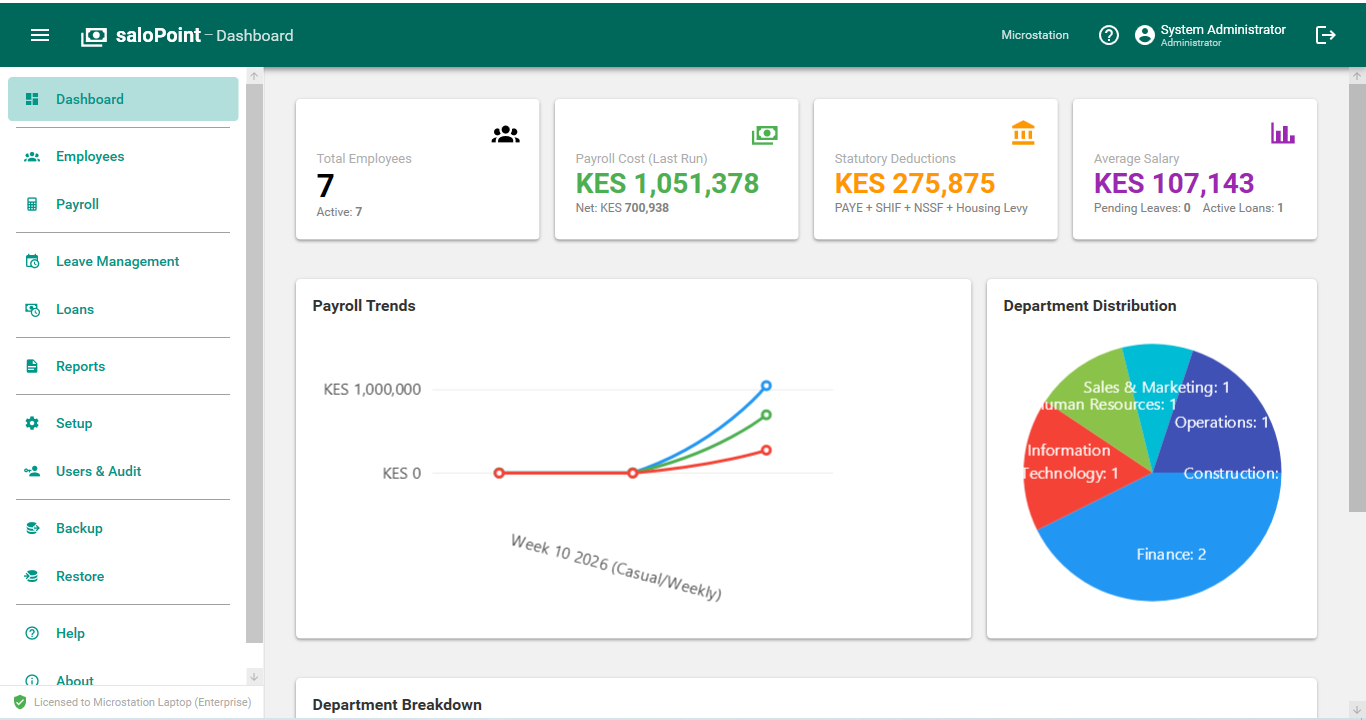
Payroll Dashboard
Employee count, payroll cost, statutory deductions and trends on one screen — with every rate kept current.
PAYE Calculation
Applies the current KRA tax bands, personal relief, insurance relief and housing relief to every employee, every pay period.
NSSF Tier I & Tier II
Splits NSSF contributions across the statutory earnings limits and keeps the employee and employer shares separate.
SHIF / SHA Contributions
Calculates Social Health Insurance Fund deductions under the Social Health Authority framework from gross salary.
Affordable Housing Levy
Computes the 1.5% employee and 1.5% employer levy on gross monthly pay for every employee.
Payslips for Every Employee
Produces a detailed payslip showing gross pay, each statutory deduction, other deductions and net pay.
P9, P10 & P10A Reports
Generates the KRA withholding tax returns and employee tax deduction cards used for monthly and annual filing.
Bank Payment Files
Creates salary payment files that major Kenyan banks accept, so net pay is released in one batch instead of one transfer at a time.
Leave, Loans & Records
Tracks annual, sick, maternity and paternity leave, employee loans and repayments alongside each employee record.
Multi-Company Payroll
Runs payroll for more than one company from a single installation — for group companies and accountants handling several clients.
Payroll Software in Kenya — What It Is and What It Must Do
Payroll software (also called a payroll system, payroll management system or payroll solution) is the program you use to calculate salaries, deductions and payslips at the end of every pay period. In Kenya it is only useful if it also handles the statutory work that comes with employing people.
Why Excel payroll costs Kenyan employers more than they think
A spreadsheet can add up a salary, but it cannot keep up with employment law. Every time a KRA tax band, NSSF tier, SHIF rate or Housing Levy rule changes, someone has to remember to edit the formula — and if that is missed, the wrong figures go to KRA and the penalties land on the employer, not on the payroll clerk.
saloPoint was built in Kenya for exactly this job. It calculates PAYE, NSSF Tier I and Tier II, SHIF/SHA and the Affordable Housing Levy from each employee's salary, then prepares payslips, KRA returns and bank payment files from the same run. Statutory rates are kept current, so payroll never depends on someone remembering a number.
Want the worked numbers first? Start with our guides on how to calculate PAYE in Kenya, NSSF Tier I and Tier II rates and SHIF contributions for employers.
PAYE Calculation
Applies the current KRA tax bands, personal relief, insurance relief and housing relief to every employee, every pay period.
NSSF Tier I & Tier II
Splits NSSF contributions across the statutory earnings limits and keeps the employee and employer shares separate.
SHIF / SHA Contributions
Calculates Social Health Insurance Fund deductions under the Social Health Authority framework from gross salary.
Affordable Housing Levy
Computes the 1.5% employee and 1.5% employer levy on gross monthly pay for every employee.
Payslips for Every Employee
Produces a detailed payslip showing gross pay, each statutory deduction, other deductions and net pay.
P9, P10 & P10A Reports
Generates the KRA withholding tax returns and employee tax deduction cards used for monthly and annual filing.
Bank Payment Files
Creates salary payment files that major Kenyan banks accept, so net pay is released in one batch instead of one transfer at a time.
Leave, Loans & Records
Tracks annual, sick, maternity and paternity leave, employee loans and repayments alongside each employee record.
Payroll Terms Kenyan Employers Search For, Explained
If you are new to running payroll, these are the words you will meet on payslips, KRA returns and NSSF or SHA statements — in plain language.
| Payroll term | What it means in Kenya |
|---|---|
| Payroll software / payroll system | Any application that calculates employee pay, applies statutory and agreed deductions, and produces payslips and statutory reports — instead of doing payroll by hand in Excel. |
| Gross pay | Everything an employee earns before deductions: basic salary, allowances, overtime, commission and taxable benefits. |
| Chargeable pay (taxable pay) | Gross pay less the deductions KRA allows, such as NSSF and registered pension contributions. PAYE is charged on this figure. |
| Net pay (take-home pay) | Gross pay less every statutory and agreed deduction — the amount actually paid to the employee. |
| PAYE | Pay As You Earn — the income tax an employer deducts from an employee’s salary each month and remits to the Kenya Revenue Authority. |
| Statutory deductions | The deductions Kenyan law requires an employer to make: PAYE, NSSF, SHIF/SHA and the Affordable Housing Levy. |
| NSSF Tier I and Tier II | The two earnings bands for NSSF contributions — 6% each from employee and employer on the first KES 9,000, then 6% on earnings between KES 9,001 and KES 108,000. |
| SHIF / SHA | The Social Health Insurance Fund collected by the Social Health Authority, currently 2.75% of gross salary. |
| Affordable Housing Levy | A 1.5% employee contribution on gross monthly pay, matched by a 1.5% employer contribution. |
| Payslip | The document each employee receives showing gross pay, deductions and net pay for a pay period. |
| P9 | The annual KRA tax deduction card summarising each employee’s PAYE for the year. |
| P10 | The monthly PAYE return an employer files with KRA, listing each employee’s taxable pay and tax deducted. |
| P10A | The supporting schedule of employee and deduction details filed together with the P10 return. |
| Payroll software vs payroll service | Software is the program your own team uses to run payroll in-house. A payroll service — a bureau or an outsourcing firm — runs payroll for you, usually for a monthly fee or a charge per payslip, and holds the records. |
| One-time licence vs subscription | A one-time licence is paid once and the software is yours to keep using. A subscription is billed every month or year, often per employee, for as long as you use the software. |
| Payroll software vs Excel | A spreadsheet only holds the numbers and formulas someone typed in. Payroll software holds the statutory rules themselves — PAYE bands, NSSF tiers, SHIF and Housing Levy rates — applies them on every run, and produces the payslips and returns from the same data. |
| iTax | KRA’s online portal for tax filing, where the employer files the monthly PAYE return, the P10A schedule and the year-end returns, and employees file their own income tax returns. |
| Pay period (payroll calendar) | The stretch of time one payroll run covers — usually a month in Kenya, but weekly or fortnightly for casual, shift and site-based staff. |
| Casual worker (daily-paid employee) | An employee whose pay is calculated by the day or by the job rather than as a monthly salary. Casual pay still has to appear in your payroll records and returns, so the days worked and the rate for each period matter. |
| Gross-to-net calculation | The full journey from gross pay, through every statutory and agreed deduction, to the net pay that actually reaches the employee’s bank account. |
Comprehensive Payroll Features
Everything you need to manage payroll in Kenya — fully compliant with all statutory requirements
PAYE Calculation
Automated PAYE computation fully compliant with current KRA tax bands and rates. Handles tax relief, insurance relief, and personal relief automatically.
NSSF Tier I & II
Handles both Tier I and Tier II NSSF contributions as per the NSSF Act. Calculates employer and employee portions accurately.
SHIF/SHA Compliance
Fully updated for the Social Health Insurance Fund (SHIF) under the Social Health Authority (SHA) framework.
Housing Levy
Automated Affordable Housing Levy calculation at the statutory rate for both employer and employee contributions.
Leave Management
Comprehensive leave tracking including annual, sick, maternity, paternity, and compassionate leave with balance monitoring.
Employee Loan Management
Track employee loans, repayment schedules, outstanding balances, and payroll deductions from one place.
Payslip Generation
Professional, detailed payslips generated automatically for each pay period. Printable and ready for distribution.
Employee Records
Centralized employee database with personal details, employment history, contract information, and document management.
Multi-Company Support
Manage payroll for multiple companies from a single installation. Ideal for group companies and holding structures.
Statutory Reports
Generate P9, P10, P10A, and other statutory reports required by KRA. Export-ready formats for seamless filing.
Bank File Generation
Generate bank-compatible salary payment files for major Kenyan banks. Supports bulk salary transfers with ease.
Who Uses saloPoint Payroll Software in Kenya
saloPoint is used by employers of every size — from a shop with three staff to groups running payroll for several companies. If people in Kenya receive a salary from you, this payroll system can run it.
Small Businesses & Start-ups
Owners who run payroll themselves and need PAYE, NSSF, SHIF and Housing Levy done correctly from the first employee.
Accountants & Bookkeepers
Practices that process payroll for client companies and want accurate statutory figures ready for KRA filing.
Finance & HR Teams
In-house payroll administrators who need payslips, leave balances, loan schedules and reports without spreadsheets.
Schools, Colleges & Academies
Boards and bursars paying teaching and support staff on different pay scales, terms and allowances.
SACCOs & Microfinance
Organisations with staff spread across branches that need one consistent, auditable payroll run each month.
NGOs, CBOs & Foundations
Programmes with donor-funded payroll that must reconcile statutory deductions and staff costs cleanly.
Churches & Religious Bodies
Organisations paying clergy and staff, often across several congregations under one administration.
Hotels, Lodges & Restaurants
Hospitality employers with shift-based and seasonal staff, service charge and variable hours.
Security & Cleaning Firms
Large, high-turnover workforces where every guard, supervisor and site clerk must appear on payroll correctly.
Retail, Wholesale & Distribution
Shops, depots and distributors paying branch staff, drivers and casuals from one central payroll.
Manufacturing & Processing
Factories and processors with shift allowances, overtime and production-based pay elements.
Group Companies & Holdings
Businesses running payroll for more than one registered company or subsidiary from a single installation.
Hospitals, Clinics & Pharmacies
Facilities paying doctors, nurses, locums and support staff on different shift patterns, allowances and on-call rates.
Law Firms & Professional Practices
Advocates, auditors, consultancies and agencies where staff may be paid a fixed salary, a retainer or a share of fees.
Transport, Logistics & Fuel Stations
Fleets, couriers and filling stations paying drivers, conductors, attendants and depot staff with overtime and route allowances.
Whoever runs payroll, the work is the same
Business owners, HR managers, finance officers, accountants and payroll clerks all use saloPoint the same way: load employee records once, add the month's changes — new hires, exits, overtime, leave, loans, salary reviews — then process payroll and print payslips. You do not need to be a tax specialist, because the statutory calculation runs in the background on every pay period.
Supporting employers across Kenya
saloPoint is installed as a Windows desktop application, so it works for employers in Nairobi, Mombasa, Kisumu, Nakuru, Eldoret, Thika, Nyeri, Machakos and every other town where the internet is not guaranteed. Payroll runs offline on your own computer, and your support team is a Nairobi phone call away.
How to Choose Payroll Software in Kenya
Eight questions that separate a payroll system you keep for years from one you abandon after two pay periods.
Does it cover every Kenyan statutory deduction?
PAYE with the current tax bands and reliefs, NSSF Tier I and Tier II, SHIF/SHA and the Affordable Housing Levy should all be calculated automatically — not typed in as a fixed percentage.
Who updates it when the rates change?
Statutory rates, bands and thresholds change. A payroll system that is not updated leaves the employer exposed to KRA, NSSF and SHA penalties, so ask who maintains the rates and how often.
Which KRA reports can it produce?
You need P9 tax deduction cards, the monthly P10 return and its P10A schedule, plus payroll summaries you can hand to an auditor. If the system cannot produce them, you will rebuild them by hand.
Is the price one-time or a monthly subscription?
Cloud payroll tools charge every month, often per employee, so the cost keeps rising as you hire. A one-time licence means the software does not get more expensive just because your team grows.
Does it run on the computers you already have?
Most Kenyan offices run Windows. A payroll system that installs on a normal Windows PC — and keeps working when the internet drops — is far easier to adopt than one that needs perfect connectivity.
Where does your payroll data live?
Salaries, KRA PINs, NSSF and SHA numbers and bank details are sensitive. Ask whether the data sits on your own computer or on a vendor’s servers, and who can access it.
Can it grow with the business?
Adding employees, departments, multiple pay structures or a second company should not force you to replace the system. Plans priced by employee capacity let you start small and scale.
Who supports and trains you locally?
When payroll must be out by the 9th, you need someone who answers the phone in your time zone. Local support, installation help and staff training are worth more than a longer feature list.
saloPoint answers all eight: Kenyan statutory calculations built in, P9/P10/P10A reports, a one-time licence with no monthly subscription, Windows installation, data on your own computer and Nairobi-based support.
Download the free trialDownload the free trial and test it on your own payroll→Choose Your Plan
Every plan includes the same complete payroll tools. Choose the employee capacity that fits your business.
Standard
Up to 50 Employees
Full saloPoint payroll access for up to 50 employees.
- ✓PAYE Calculation & KRA Compliance
- ✓SHIF Contributions
- ✓NSSF Tier I & II Deductions
- ✓Housing Levy Calculation
- ✓Payslip Generation
- ✓Employee Records Management
- ✓Statutory Reports (P9, P10)
- ✓Leave Management
- ✓Employee Loan Management
- ✓Email Support
Pro
Up to 200 Employees
Full saloPoint payroll access for up to 200 employees.
- ✓PAYE Calculation & KRA Compliance
- ✓SHIF Contributions
- ✓NSSF Tier I & II Deductions
- ✓Housing Levy Calculation
- ✓Payslip Generation
- ✓Employee Records Management
- ✓Statutory Reports (P9, P10)
- ✓Leave Management
- ✓Employee Loan Management
- ✓Email Support
Enterprise
Unlimited Employees
Full saloPoint payroll access for unlimited employees.
- ✓PAYE Calculation & KRA Compliance
- ✓SHIF Contributions
- ✓NSSF Tier I & II Deductions
- ✓Housing Levy Calculation
- ✓Payslip Generation
- ✓Employee Records Management
- ✓Statutory Reports (P9, P10)
- ✓Leave Management
- ✓Employee Loan Management
- ✓Email Support
How Much Does Payroll Software Cost in Kenya?
Payroll software in Kenya is priced in one of two ways: a monthly subscription that keeps charging for as long as you use it, or a one-time licence. saloPoint is a one-time licence — here is how the options compare.
| Option | How you pay | Typical cost | What to watch |
|---|---|---|---|
| Manual payroll in Excel | Staff time, every month | No licence fee — but no automation either | Recalculation errors, missed statutory rate changes and KRA penalties for under-deducted PAYE, with no payslips or statutory reports generated for you. |
| Cloud payroll subscription | Monthly or annual, usually per employee | An ongoing fee for as long as you use the software | The bill grows with your headcount, you need a connection to run payroll, and your employee data sits on the vendor’s servers. |
| Outsourced payroll / payroll bureau | Monthly retainer or a fee per payslip | An ongoing service fee that rises with headcount | Payroll control and the employee records sit with the provider, and per-payslip charges grow as you hire. You also wait on someone else when a correction or an extra report is needed. |
| Free or entry-level payroll app | Free tier first, then a paid upgrade | Nothing to start, but usually capped | Employee limits, locked features and report restrictions, and no guarantee that the Kenyan statutory rates are kept up to date for you. Check who maintains the PAYE, NSSF, SHIF and Housing Levy rules before you rely on it. |
| saloPoint Standard | One-time licence | KES 20,000 for up to 50 employees | Nothing monthly. The licence does not rise in price as you hire. |
| saloPoint Pro | One-time licence | KES 25,000 for up to 200 employees | Nothing monthly. The licence does not rise in price as you hire. |
| saloPoint Enterprise | One-time licence | KES 35,000 for unlimited employees | Nothing monthly. The licence does not rise in price as you hire. |
Manual payroll in Excel
- How you pay
- Staff time, every month
- Typical cost
- No licence fee — but no automation either
- What to watch
- Recalculation errors, missed statutory rate changes and KRA penalties for under-deducted PAYE, with no payslips or statutory reports generated for you.
Cloud payroll subscription
- How you pay
- Monthly or annual, usually per employee
- Typical cost
- An ongoing fee for as long as you use the software
- What to watch
- The bill grows with your headcount, you need a connection to run payroll, and your employee data sits on the vendor’s servers.
Outsourced payroll / payroll bureau
- How you pay
- Monthly retainer or a fee per payslip
- Typical cost
- An ongoing service fee that rises with headcount
- What to watch
- Payroll control and the employee records sit with the provider, and per-payslip charges grow as you hire. You also wait on someone else when a correction or an extra report is needed.
Free or entry-level payroll app
- How you pay
- Free tier first, then a paid upgrade
- Typical cost
- Nothing to start, but usually capped
- What to watch
- Employee limits, locked features and report restrictions, and no guarantee that the Kenyan statutory rates are kept up to date for you. Check who maintains the PAYE, NSSF, SHIF and Housing Levy rules before you rely on it.
saloPoint Standard
- How you pay
- One-time licence
- Typical cost
- KES 20,000 for up to 50 employees
- What to watch
- Nothing monthly. The licence does not rise in price as you hire.
saloPoint Pro
- How you pay
- One-time licence
- Typical cost
- KES 25,000 for up to 200 employees
- What to watch
- Nothing monthly. The licence does not rise in price as you hire.
saloPoint Enterprise
- How you pay
- One-time licence
- Typical cost
- KES 35,000 for unlimited employees
- What to watch
- Nothing monthly. The licence does not rise in price as you hire.
Prices are in Kenya Shillings and subject to applicable taxes. Cloud payroll pricing varies between vendors in the Kenyan market and is shown here only as a way of paying, not as a quoted price. Please confirm current figures with each provider.
What Drives the Price of Payroll Software in Kenya
Two Kenyan employers can be quoted very different figures for the same job. These are the things that actually move the number, so a quote can be compared on equal terms.
Number of employees
Almost every Kenyan quote scales with headcount — as a licence tier, a monthly per-employee charge or a fee per payslip. A 50-employee payroll never costs the same as a 5-employee one.
Deployment: desktop or cloud
A Windows desktop licence is normally paid once. Cloud payroll is billed monthly or annually, so the total keeps accruing for as long as you use it.
Which modules are included
Payroll on its own is cheaper than payroll bundled with HR, leave, loans, time and attendance or an accounting module. Check what is in the box before comparing two quotes.
Who keeps the statutory rates current
Someone has to maintain the PAYE bands and reliefs, NSSF Tier I and Tier II limits, the SHIF/SHA rate and the Housing Levy rate. If updates cost extra — or stop — the cheapest quote becomes the most expensive mistake.
Support, training and installation
Local installation, staff training, data migration and a support number that answers in your time zone are usually priced in, sometimes invisibly, to a subscription.
How many companies you run payroll for
Group companies, holdings and accounting practices processing payroll for several entities are often charged per company or pushed into a higher tier.
saloPoint leaves one variable in play — how many employees you have. Everything else above is included in the one-time licence, so the KES 20,000 Standard licence stays KES 20,000 whether payroll runs once or every month for years.
Every saloPoint licence includes the full payroll feature set
- ✓PAYE, NSSF Tier I & II, SHIF/SHA and Housing Levy calculated automatically
- ✓Payslip generation for every employee
- ✓P9, P10 and P10A statutory reports
- ✓Bank payment files for salary transfers
- ✓Employee records, leave and loan management
- ✓Multi-company payroll from one installation
- ✓Email support
Test it before you spend anything
Download the trial, run your own employees and payslips, and check the figures yourself. Statutory calculations, payslips and reports are all available in the trial.
Try saloPoint Free
Download the trial version and experience the power of Kenya's most comprehensive payroll management system. No credit card required.
Compatible with Windows • Easy installation • Full feature trial
Kenya Statutory Payroll Rates at a Glance
saloPoint keeps every Kenyan statutory deduction up to date — PAYE tax bands, NSSF tiers, SHIF/SHA and the Affordable Housing Levy — so your payroll is always compliant without manual rate lookups.
PAYE (KRA)
10% – 35%
Five progressive monthly bands with KES 2,400 personal relief
NSSF Tier I
6% of the first KES 9,000
Employee & employer each contribute up to KES 540
NSSF Tier II
6% of KES 9,001 – 108,000
Employee & employer each contribute up to KES 5,940
SHIF / SHA
2.75% of gross salary
Social Health Insurance Fund contributions via SHA
Affordable Housing Levy
1.5% + 1.5%
Employee 1.5% and employer 1.5% of gross salary
Current KRA PAYE Tax Bands (Monthly)
| Chargeable Monthly Income | Tax Rate |
|---|---|
| Up to KES 24,000 | 10% |
| KES 24,001 – KES 32,333 | 25% |
| KES 32,334 – KES 500,000 | 30% |
| KES 500,001 – KES 800,000 | 32.5% |
| Above KES 800,000 | 35% |
Plus KES 2,400 monthly personal relief. Insurance and Affordable Housing relief are applied where applicable.
Worked Example: Payroll for a KES 60,000 Monthly Salary
These are the two calculations saloPoint runs for every employee on every pay period — the tax on chargeable pay, and the statutory deductions taken from gross pay.
Step 1 — PAYE on a taxable pay of KES 53,850
- Gross salary less NSSF, SHIF and the levyKES 53,850.00
- First KES 24,000 × 10%KES 2,400.00
- Next KES 8,333 × 25%KES 2,083.25
- Remaining KES 21,517 × 30%KES 6,455.10
- Gross taxKES 10,938.35
- Less monthly personal relief− KES 2,400.00
Net PAYE payable: KES 8,538.35
Taxable pay is the KES 60,000 gross salary less the NSSF, SHIF and Housing Levy shown in Step 2. Insurance relief reduces the tax further where the employee qualifies, and a registered pension or deductible mortgage interest would lower the taxable pay — saloPoint handles each one automatically.
Step 2 — Statutory deductions on a KES 60,000 gross salary
| Deduction | Employee | Employer |
|---|---|---|
| NSSF Tier I (6% of KES 9,000) | KES 540 | KES 540 |
| NSSF Tier II (6% of KES 51,000) | KES 3,060 | KES 3,060 |
| SHIF / SHA (2.75% of gross) | KES 1,650 | — |
| Affordable Housing Levy (1.5% of gross) | KES 900 | KES 900 |
| Total per month | KES 6,150 | KES 4,500 |
Illustrative only, based on a KES 60,000 monthly gross salary with no other allowances or deductions. Taxable pay for PAYE is gross pay less the deductions KRA allows — NSSF, SHIF, the Affordable Housing Levy, registered pension contributions and deductible mortgage interest — which is why the KES 60,000 salary above is taxed on KES 53,850, the same way KRA's own PAYE calculator works.
PAYE, NSSF, SHIF, the Housing Levy, net pay and the employer cost — worked out instantly for any monthly salary.
⚠️ Statutory rates and thresholds change — always confirm the current figures on the official KRA, NSSF and SHA/SHIF portals. NSSF's lower and upper earnings limits in particular are advised by NSSF from time to time, so re-check the ceiling as well as the 6% rate. saloPoint is regularly updated so your payroll stays compliant automatically.
Get Started in 4 Simple Steps
From download to your first payroll run — it's quick, easy, and straightforward
Download & Install
Download the saloPoint trial version, uncompress the zip file and run salopoint.exe on your Windows computer. Use Admin and Admin123 as the username and password respectively. Do not forget to set your preferred username and password after logging in for the first time.
Configure Your Company
Set up your company details, payment schedules, and statutory registration numbers (KRA PIN, SHIF, NSSF). Define departments and pay structures.
Add Employees
Enter employee details including personal information, bank accounts, tax PINs, and salary structures.
Run Your First Payroll
Process payroll with a single click. saloPoint automatically calculates all statutory deductions, generates payslips, and prepares compliance reports.
Payroll Services in Kenya — What Comes With saloPoint
Buying payroll software is only one part of running payroll. These are the services Microstation provides around saloPoint, so your team is never left alone with a new system at month end.
Payroll Setup & Implementation
We help you configure your company details, pay schedules, statutory registration numbers, departments and pay structures so the first payroll run is correct.
Employee Records Set-Up
Assistance loading employee details, salary structures, KRA PINs, NSSF and SHA numbers, bank accounts and opening leave or loan balances.
Statutory Rate Updates
When KRA bands, NSSF tiers, SHIF rates or the Housing Levy change, saloPoint is updated so your payroll stays compliant without manual rate lookups.
Payslip & Report Templates
Set up payslips, payroll summaries, P9/P10/P10A reports and bank payment files in the formats your bank, auditor and KRA submissions expect.
Training for Your Team
Hands-on training for whoever runs payroll — processing a month, adjusting a salary, handling a new hire or exit, and printing payslips.
Local Support & Enhancements
Ongoing Nairobi-based support by phone and email, plus bespoke work such as extra allowances and deductions, custom report formats or integrations.
In-house payroll or a payroll bureau?
Many Kenyan employers weigh a payroll bureau or outsourcing service against doing payroll in-house. saloPoint is the in-house route: a one-time licence instead of a monthly per-payslip charge, your employee data kept on your own computer, and payroll processed the moment you need it rather than waiting on a third party. If you prefer to keep critical payroll records inside your business, that control is the point.
Need payroll inside a bigger system?
If payroll has to talk to your accounting system, ERP or an internal application, our teams can extend saloPoint or build the integration around it.
How saloPoint Compares
See how saloPoint stacks up against the options most Kenyan businesses use today
Manual Spreadsheets & Excel
Most Kenyan SMEs start payroll on Excel — then pay the price every pay period.
- ✕Manual PAYE bands and NSSF tiers are error-prone
- ✕No automatic P9, P10 or P10A tax reports
- ✕Missed statutory updates can trigger KRA penalties
- ✕No payslip or bank payment file generation
Generic / Foreign Cloud Payroll
International tools may handle basic payroll — but not always Kenyan statutory requirements.
- ✕Ongoing monthly or annual subscription costs
- ✕SHIF, NSSF Tier II and Housing Levy often not covered
- ✕P9/P10/P10A formats may not match KRA requirements
- ✕Needs an internet connection and still needs local setup
saloPoint — Built for Kenya
A complete Kenyan payroll system developed and supported locally by Microstation since 1995.
- ✓PAYE, NSSF Tier I & II, SHIF/SHA and Housing Levy automated
- ✓P9, P10 and P10A statutory reports generated automatically
- ✓One-time license — no monthly subscription
- ✓Works offline on Windows, no internet required
- ✓Local Nairobi-based support and training
Payroll Software in Kenya: Frequently Asked Questions
Common questions about Kenyan payroll software, statutory deductions, pricing and saloPoint
saloPoint runs on Windows operating systems. It is compatible with Windows 10 and later versions.
Yes. saloPoint calculates Kenyan statutory payroll deductions including PAYE, NSSF, SHIF/SHA, and Housing Levy, then helps prepare the related payroll reports.
Yes, saloPoint is fully compliant with all Kenyan statutory requirements including PAYE (KRA), NSSF Tier I & II, SHIF/SHA, and Housing Levy. We regularly update the system to reflect any changes in tax rates or regulations.
All three plans include the same complete saloPoint payroll features. The only difference is employee capacity: Standard supports up to 50 employees, Pro supports up to 200 employees, and Enterprise supports unlimited employees.
Yes. You can download the saloPoint trial from this page and test the payroll workflow before purchasing a full license from Microstation.
Yes, saloPoint generates all required statutory reports including P9, P10, P10A tax deduction cards, SHIF returns, NSSF returns, and Housing Levy reports — all in formats ready for submission to the relevant authorities.
You can start with our free trial download to evaluate the software. To purchase the full version, contact Microstation via phone (+254 722 711 162/731 822 629) or email (kiarie@microstation.co.ke) and we will help you choose the right plan for your business.
saloPoint is a one-time licence: KES 20,000 for up to 50 employees, KES 25,000 for up to 200 employees and KES 35,000 for unlimited employees, with no monthly subscription. Cloud payroll tools in Kenya usually charge every month, often per employee, so the total keeps rising for as long as you use them. A full breakdown sits on this page under How Much Does Payroll Software Cost in Kenya.
The best payroll software for your business is the one that calculates every Kenyan statutory deduction correctly, produces the reports KRA, NSSF and SHA require, and that your team can actually use. saloPoint is built and supported in Kenya by Microstation, covers PAYE, NSSF Tier I and Tier II, SHIF/SHA and the Affordable Housing Levy, and is available as a free trial so you can test it on your own payroll before deciding.
You can download the saloPoint trial free of charge and run the complete payroll workflow — employee records, statutory calculations, payslips and reports — before buying a licence. The full version is then a one-time licence from KES 20,000 rather than an ongoing subscription.
No. saloPoint is installed on a Windows computer and runs offline, so payroll can be processed even when the internet is down. You only need a connection to download the trial and to reach support by email.
saloPoint is a Windows desktop payroll system that runs on your own computer. Employee records, salaries and bank details stay on your machine instead of being held on a vendor cloud platform, and there is no monthly hosting fee.
Yes. saloPoint supports multi-company payroll from a single installation, which suits group companies, holding structures, and accountants who process payroll for several clients.
Download and install saloPoint, configure your company details and statutory registration numbers, add employees with their salary structures and bank details, then process payroll for the pay period. saloPoint calculates PAYE, NSSF, SHIF/SHA and the Housing Levy, generates payslips and prepares your statutory reports from the same run.
A Kenyan employer deducts PAYE for KRA, NSSF Tier I and Tier II contributions, SHIF/SHA health contributions and the Affordable Housing Levy, each calculated on the employee’s gross pay within the current statutory limits. saloPoint applies all of them automatically and is updated whenever the rates or thresholds change.
saloPoint generates bank-compatible salary payment files for major Kenyan banks, so net pay can be released as a bulk transfer instead of one payment at a time. Payslips are produced in the same run.
Yes. saloPoint tracks annual, sick, maternity, paternity and compassionate leave with balances, and manages employee loans with repayment schedules and outstanding balances recovered through payroll.
Yes. The Standard licence covers up to 50 employees for a one-time KES 20,000, which is designed for small businesses and start-ups that want statutory compliance without a monthly bill. As you grow you can move to Pro for up to 200 employees or Enterprise for unlimited employees without changing systems.
Each month an employer files a P10 return showing the PAYE deducted for every employee, supported by the P10A schedule, and at year end issues P9 tax deduction cards. saloPoint produces these reports from your payroll data, ready for your KRA iTax filing.
Microstation provides installation guidance, payroll setup assistance, training for your team, and ongoing support by phone and email from Nairobi. Statutory rate updates are applied to saloPoint whenever the law changes.
Yes. Extra allowances and deductions, custom report formats, and integrations with accounting, ERP or in-house systems can be built around saloPoint. Contact Microstation and tell us which reports and workflows your business needs.
Download the saloPoint trial from this page, unzip the file and run the installer on a Windows 10 or later computer. The trial covers the full payroll workflow — employee records, statutory calculations, payslips and reports — so you can load a few employees and check the figures before buying a licence. If you would rather be walked through it, contact Microstation and we will help with the installation.
Yes. saloPoint is sold as a one-time licence — KES 20,000 for up to 50 employees, KES 25,000 for up to 200 employees and KES 35,000 for unlimited employees — with no monthly or annual fee. Cloud payroll tools in Kenya are usually billed every month, often per employee, so their total cost keeps rising for as long as you use them.
The saloPoint Standard licence covers up to 50 employees for a one-time KES 20,000, which works out at about KES 400 per employee — paid once, not every month. If your headcount later passes 50, the Pro licence covers up to 200 employees for KES 25,000 and Enterprise covers unlimited employees for KES 35,000.
A Kenyan employer has to deduct PAYE, NSSF, SHIF/SHA and the Housing Levy and file the related returns even with three or four staff, and the rates and thresholds change often. Payroll software keeps those calculations consistent, produces the payslips employees are entitled to, and generates the P9, P10 and P10A reports — work that is easy to get wrong in a spreadsheet.
A spreadsheet stores the numbers you type into it; payroll software applies the law. saloPoint holds the current PAYE bands and reliefs, the NSSF Tier I and Tier II limits, the SHIF/SHA rate and the Housing Levy rate, applies them to every employee automatically, then produces payslips, P9/P10/P10A reports and bank payment files from the same run. When a rate changes, the calculation changes with it instead of waiting for someone to edit a formula.
Yes. Casual and daily-paid staff can be recorded with daily rates or days worked, their pay for the period is calculated from that, and the statutory deductions are applied the same way as for monthly employees — all in the same payroll run. Always confirm the current rules for casual employment with the relevant authority before finalising a period.
A Kenyan payslip should identify the employer and the employee (including the employee KRA PIN, NSSF and SHA numbers), the pay period, gross pay, every deduction — PAYE, NSSF Tier I and Tier II, SHIF/SHA, the Housing Levy and any other agreed deduction — the employer contributions, and the net pay. saloPoint prints a detailed payslip of this kind for each employee.
Payroll software is the program your own team uses to run payroll in-house. A payroll bureau or outsourcing service runs payroll for you, usually for a monthly fee or a charge per payslip, and keeps the records. saloPoint is the in-house route — a one-time licence, your employee data on your own computer, and payroll processed when you need it — with setup, training and support from Microstation if you want help.
Yes. saloPoint produces the payroll figures and reports you need for iTax: the monthly PAYE return figures with the P10A employee schedule, and the P9 tax deduction cards issued to employees at year end. You file on iTax as normal — the reports come out of the payroll run instead of being rebuilt by hand.
Payroll Guides & Resources
Practical guidance on Kenyan statutory payroll, written by the team behind saloPoint
Ready to Simplify Your Payroll?
Join businesses across Kenya using saloPoint to automate payroll processing, ensure statutory compliance, and save valuable time.